
What Should a High School Drone Curriculum Include?

A strong high school drone curriculum should teach students much more than how to fly an aircraft.
Students need the knowledge to understand aviation rules and safety, the opportunity to develop real flight skills, and projects that show them how drones are used beyond the classroom.
For schools building a STEM or CTE drone program, the strongest curriculum brings those pieces together rather than treating Part 107 preparation, flight training, safety, and career exploration as separate subjects.
1. FAA Part 107 Knowledge
For programs preparing students for commercial drone operations or the FAA Part 107 exam, aviation knowledge should be an important part of the curriculum.
Students should develop an understanding of topics such as:
- Airspace
- Weather
- Regulations
- Flight operations
- Aircraft performance
- Risk and decision-making
But Part 107 preparation should go beyond memorizing answers for an exam. Students benefit from understanding why aviation rules exist and how those rules affect decisions they may eventually make as drone operators.
For students interested in taking the next step, high school students can earn an FAA Remote Pilot Certificate once they meet the FAA’s eligibility requirements. Learn more about Part 107 for high school students.
DARTdrones Instructor Insight
DARTdrones instructors recommend combining hands-on flying with an immersive approach to Part 107 so students understand the reasoning behind aviation rules—not simply the information they need to remember for a test.
2. Hands-On Flight Training
Students cannot develop drone-piloting skills from classroom instruction alone.
A high school drone curriculum should provide regular opportunities for students to control aircraft themselves and gradually develop the motor skills, judgment, and confidence required for more advanced operations.
Beginning students can start with small microdrones in a controlled indoor environment.
Simple exercises might include:
- Takeoffs and landings
- Hovering
- Maintaining orientation
- Flying predetermined patterns
- Navigating around obstacles
- Precision landing
- Basic obstacle courses
Drone simulators can also provide additional practice, particularly when weather, equipment availability, or classroom limitations make physical flight difficult.
3. Drone Safety and Risk Management
Safety should not exist as one isolated lesson at the beginning of the semester.
It should become part of how students approach every flight.
Students should learn concepts such as:
- Preflight planning
- Aircraft inspections
- Battery safety
- Selecting appropriate flight areas
- Identifying hazards
- Maintaining situational awareness
- Responding when a flight does not go as planned
- Making responsible go/no-go decisions
As students move into more complex missions, they should continue applying those habits rather than simply completing a safety unit and moving on.
4. A Balance Between Classroom Learning and Flying
Schools sometimes face a difficult question:
How much time should students spend studying Part 107 material versus actually flying?
There is no universal percentage that every high school must follow. Program length, student goals, available equipment, and whether students are preparing for certification will all affect the balance.
However, hands-on learning should represent a meaningful portion of the course.
DARTdrones Instructor Recommendation
As a general instructional model, one DARTdrones instructor recommends approximately:
-
30% Part 107 and aviation knowledge
-
60% hands-on flight and real-world missions
-
10% dedicated safety instruction
Safety would then continue to be reinforced throughout the remaining flight activities and missions.
5. Real-World Missions and Drone Applications
Once students develop basic flight skills, the curriculum should give them a reason to use those skills.
Real-world projects can make drone education more engaging because students are working toward an actual outcome instead of simply completing another flight exercise. They also help students understand that professional drone work often involves much more than piloting an aircraft.
Potential projects can include:
Obstacle Courses
Students can begin with indoor obstacle courses and gradually progress to larger outdoor courses as their skills improve.
These activities help develop aircraft control, spatial awareness, precision, and confidence.
School Photography and Video
Students could capture aerial photos or video for:
- School clubs
- Yearbooks
- Campus communications
- Athletics
- School video announcements
- Other approved school projects
These projects introduce an important part of professional drone work: using the aircraft to create a useful deliverable for someone else.
Automated Missions
More advanced students can begin learning how drones use automated flight planning rather than relying exclusively on manual flight.
This can introduce students to the technology behind many commercial drone operations and help them understand how mission planning connects to data collection.
Mapping and Photogrammetry
Students may also be introduced to mapping and photogrammetry projects, where images collected by a drone are processed into usable data, maps, or models.
This helps students see what happens after the aircraft lands. In many professional environments, flying the drone is only the first step.
As students advance, a high school drone curriculum can expose them to applications such as:
- Photography and videography
- Mapping
- Photogrammetry
- 3D modeling
- Inspection workflows
- Data analysis
- Automated missions
These experiences give students a broader understanding of how drones are used across different industries and help reinforce that drone careers can involve much more than simply flying.
6. Career Exploration and Professional Skills
Drone education can also introduce students to the industries and professional skills connected to unmanned aircraft technology.
Drone technology is used in fields such as:
- Mapping and surveying
- Construction
- Infrastructure inspection
- Utilities
- Public safety
- Photography and film
- Agriculture
- Data collection and analysis
Students may also encounter technologies and workflows involving photogrammetry, 3D mapping, LiDAR, inspection data, and other advanced applications.
The goal is not for every student to become a professional drone pilot. Instead, students should begin to understand how aviation, technology, data collection, and problem-solving connect to a wide range of careers.
Professional drone work also requires skills beyond operating the aircraft. Students should have opportunities to practice:
- Organizing collected data
- Selecting appropriate images or deliverables
- Explaining their process
- Presenting findings
- Responding to a client or project request
- Communicating with team members
- Working as part of a flight team
DARTdrones instructors also recommend exposing students to the communication and presentation skills needed to turn information collected during a mission into something another person can actually use.
These skills can serve students whether they eventually work directly with drones or pursue another technical career.
7. Teacher Resources and Support
A strong curriculum must work for the person teaching it, not just the students taking it.
Many teachers entering drone education do not begin as aviation experts.
A teacher-ready program should provide clear instructional resources that help educators understand:
- What to teach
- How lessons should progress
- How classroom learning connects to flight activities
- What equipment is required
- How to reinforce safety
- Where to find additional help when questions arise
Teacher preparation and ongoing support become especially important when a school is introducing drones for the first time.
8. A Clear Progression From Beginner to Advanced Skills
Finally, the course should have a logical progression.
Students should not move randomly between Part 107 lessons, flying activities, and advanced technology.
A progression might look something like:
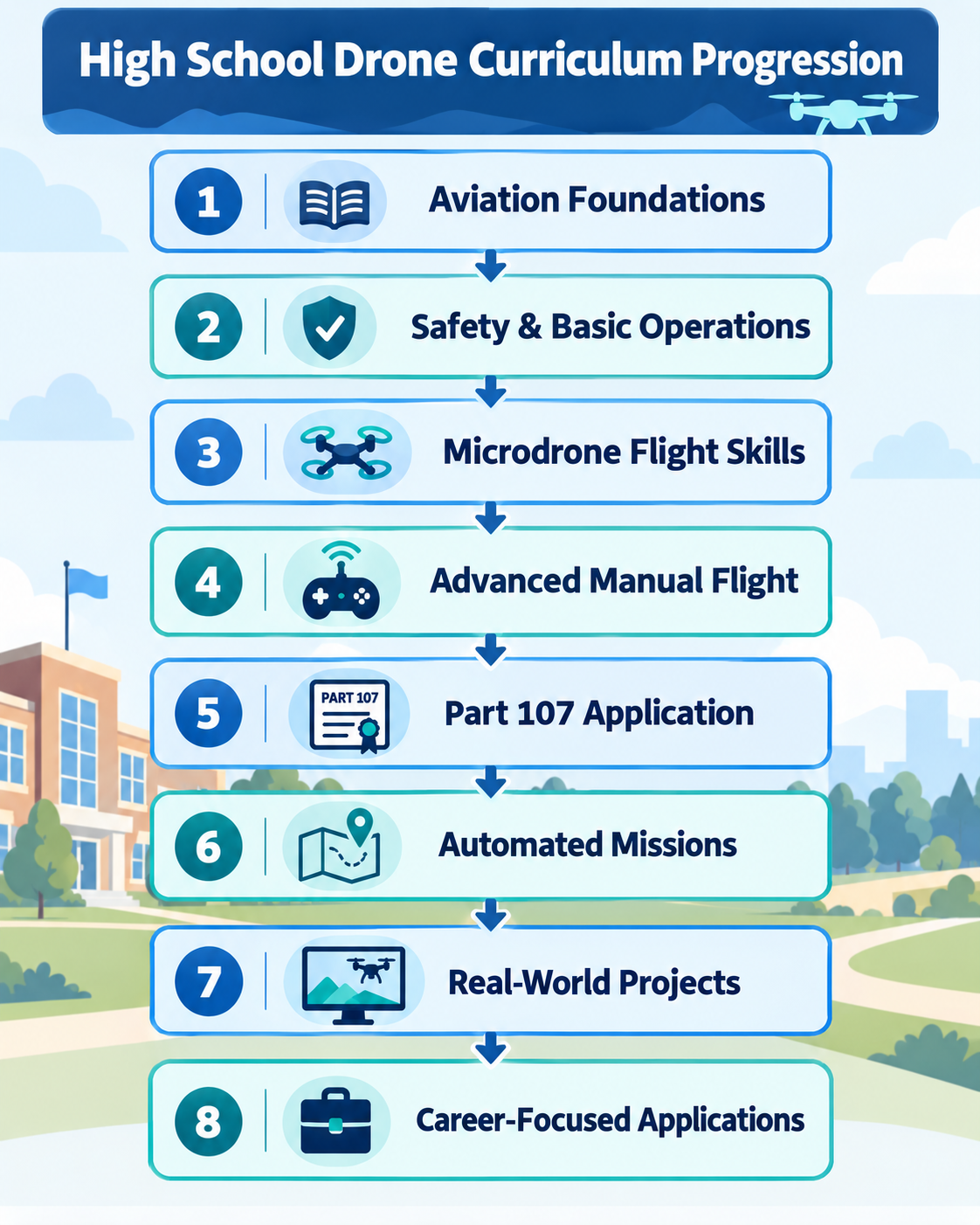
The exact structure will vary by program, but students should be able to build on skills they learned earlier rather than encountering each subject in isolation.
What Does a Complete High School Drone Program Look Like?
The strongest high school drone programs bring several elements together:
| Curriculum Component | What Students Develop |
| Part 107 & Aviation Knowledge | Understanding of regulations, weather, airspace, operations and aviation decision-making |
| Hands-On Flight Training | Aircraft control, orientation, precision and confidence |
| Safety | Risk awareness, planning and responsible flight habits |
| Real-World Missions | Experience applying flight skills toward useful outcomes |
| Drone Technology | Exposure to automation, mapping, imagery and data collection |
| Career Exploration | Awareness of industries and career pathways using drone technology |
| Professional Skills | Communication, teamwork, problem-solving and presenting information |
A drone curriculum becomes much more valuable when these areas reinforce one another.
Students learn aviation concepts, apply them during flight, use their flight skills to complete meaningful projects, and begin seeing how those same skills connect to careers.
See What a High School Drone Curriculum Can Include
DARTdrones’ high school curriculum combines classroom instruction, FAA Part 107 preparation, hands-on flight activities, career exploration, and teacher planning resources.
Explore More Curriculum Samples
Build a Drone Program That Goes Beyond the Test
Preparing students for Part 107 can be an important goal, but it should not be the finish line.
A comprehensive drone program gives students opportunities to understand aviation, become capable and responsible pilots, complete real-world projects, explore emerging technology, and discover where those skills could take them next.
DARTdrones provides high school drone curriculum, Part 107 preparation, hands-on flight training, and teacher support designed to help schools bring those pieces together.
Explore High School Drone Curriculum
Schedule a Call
FAQs
What should a high school drone curriculum teach?
A comprehensive program can include aviation and Part 107 knowledge, hands-on flight skills, safety, real-world drone missions, career exploration, data applications, and professional skills such as communication and teamwork.
Should high school drone programs include Part 107 preparation?
Part 107 preparation can be particularly valuable for programs focused on career and technical education. Schools can combine aviation knowledge with hands-on flight and real-world applications rather than making test preparation the sole focus of the course.
How much hands-on flying should students do?
There is no single percentage that works for every program. One DARTdrones instructor recommends a model of roughly 60% hands-on flight and real-world missions, 30% Part 107 instruction, and 10% dedicated safety instruction, with safety reinforced throughout the entire course.
What types of drones should high school students learn to fly?
Students can begin with microdrones that allow them to develop fundamental control skills in a manageable environment and progress toward larger or more advanced aircraft as their skills develop.
What are good drone projects for high school students?
Projects can include obstacle courses, photography and video, automated missions, mapping, photogrammetry, and projects that produce actual deliverables for a school or classroom scenario.