Can High School Students Get a Part 107 Drone License?
Yes. High school students who are at least 16 years old can earn an FAA Remote Pilot Certificate if they meet the FAA’s eligibility requirements and pass the required aeronautical knowledge exam.
Although people commonly call it a “Part 107 drone license,” the FAA officially calls the credential a Remote Pilot Certificate with a small UAS rating. It allows qualified pilots to act as remote pilots in command for drone operations conducted under the FAA’s Part 107 rules.
That means some students can earn a professional aviation credential before they even graduate from high school. But certification does not need to be the starting point, or the only goal, of a high school drone program.
What Is FAA Part 107 Certification?
Part 107 is the FAA rule that governs many non-recreational small drone operations in the United States. A person acting as the remote pilot in command under Part 107 must hold a Remote Pilot Certificate with a small UAS rating.
For students interested in careers involving drones, Part 107 introduces much more than the rules for flying an aircraft. Students learn how to interpret airspace, evaluate weather, make safe operational decisions, understand flight restrictions, and take responsibility for an aviation operation.
That is why Part 107 preparation can fit naturally into a high school CTE, STEM, aviation, or workforce-readiness program.
How Old Do You Have to Be to Get a Part 107 Certificate?
The minimum age is 16.
For a first-time applicant, the FAA currently requires the student to:
- Be at least 16 years old
- Be able to read, speak, write, and understand English
- Be in a physical and mental condition to safely fly a drone
- Pass the Unmanned Aircraft General – Small (UAG) aeronautical knowledge exam
Students first create an FAA Tracking Number through IACRA, schedule the exam at an FAA-approved knowledge testing center, pass the exam, and then complete the FAA application process.
Can Students Younger Than 16 Start Preparing for Part 107?
Absolutely.
A student does not need to wait until their 16th birthday to begin learning aviation concepts, developing flight skills, or studying Part 107 material.
Younger high school students can begin building knowledge of airspace, weather, regulations, safety, preflight procedures, and aeronautical decision-making while gaining hands-on experience with drones. Then, once they become eligible, they already have a strong foundation for formal Part 107 preparation.
This also allows schools to build certification into a multi-year learning pathway instead of treating it as a one-time test-prep activity.
What Do High School Students Need to Learn for the Part 107 Exam?
The Part 107 knowledge exam covers considerably more than drone controls.
FAA knowledge areas include regulations, airspace and flight restrictions, aviation weather, aircraft loading and performance, emergency procedures, crew resource management, radio communications, aeronautical decision-making, airport operations, and preflight and maintenance procedures.
The current FAA Airman Certification Standards organize the exam into five major areas: Regulations, Airspace & Requirements, Weather, Loading & Performance, and Operations.
For high school students, this is one reason structured instruction can be valuable. Many of these concepts are completely new to students who have never studied aviation before.
DARTdrones Instructor Insight
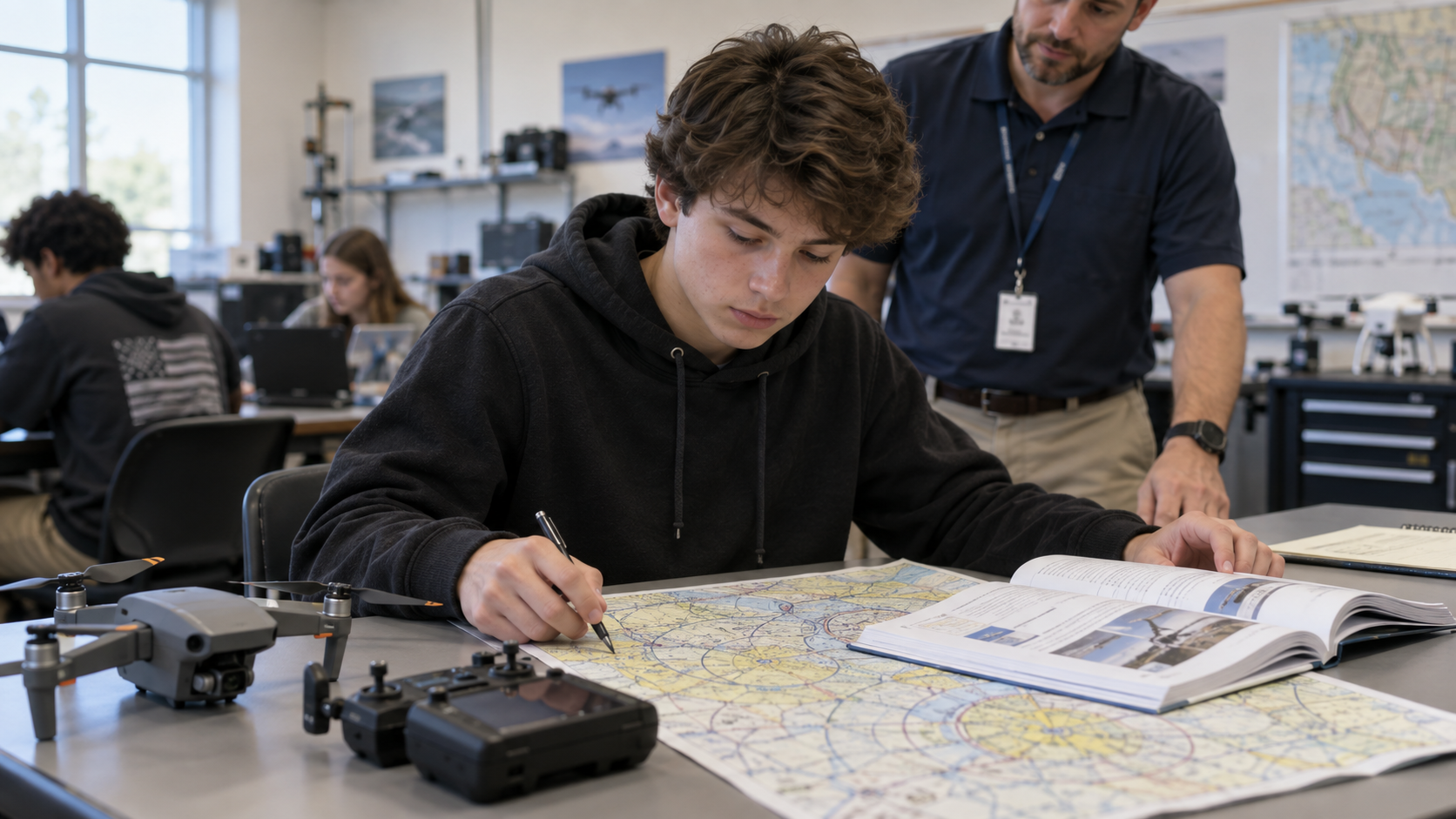
Maps and weather tend to be some of the most challenging Part 107 topics for high school students. DARTdrones instructors recommend reinforcing those concepts through real-world application, such as reviewing local airspace and current weather conditions regularly instead of treating them only as material students need to memorize for the exam.
How Should Part 107 Fit Into a High School Drone Program?
Part 107 preparation should be one part of a broader drone education program, not the entire program.
Students may learn the regulations and aviation concepts needed for the exam while also developing hands-on flight skills, practicing safe operations, completing mission-based activities, and learning how drones are used professionally.
That combination helps students understand why the regulations matter.
For example, learning about airspace in a textbook is useful. Learning how to evaluate the airspace around an actual planned drone mission gives students an opportunity to apply that knowledge.
DARTdrones Insight
Part 107 preparation is one of the areas schools most frequently ask DARTdrones about when evaluating a high school drone program, along with hands-on flight training and teacher preparation.
Why Can Part 107 Be Valuable for High School Students?
For an eligible student interested in professional drone operations, earning Part 107 can provide an aviation credential before graduation.
More importantly, preparing for the certificate requires students to develop knowledge that carries into real-world drone operations: understanding regulations, assessing conditions, planning flights, identifying hazards, and making responsible decisions.
A Part 107 certificate can also serve as a starting point rather than an end goal. Students can continue building skills in areas such as mapping, inspections, public safety, photography and videography, construction, infrastructure, and other professional drone applications.
That is where a school drone program can move from “learn how to fly a drone” to genuine career and technical education.
Does Every Student Need to Earn Part 107?
No.
Part 107 certification can be a valuable goal for eligible students, but a high school drone program can still provide meaningful technical and career education for students who are younger than 16 or who do not plan to pursue certification immediately.
Students can still learn:
- Aviation and safety concepts
- Hands-on flight skills
- Mission planning
- Technical problem-solving
- Responsible decision-making
- How drones are used across different industries
For some students, Part 107 may become the next step later. For others, the course may introduce them to aviation, engineering, data, public safety, media, or another career field they had not previously considered.
Can a Student Fly a Drone Before They Have Part 107?
Yes, but the rules governing the flight matter.
For an operation conducted under Part 107, the FAA says the person operating the controls must either hold a Remote Pilot Certificate or be under the direct supervision of someone who does.
Schools should therefore determine which FAA rules apply to their planned flight activities rather than assuming every school flight is recreational. The FAA specifically notes that even an activity such as taking drone photos of a high school football game for the school’s website is considered non-recreational.
That distinction is another reason instructor preparation and clearly defined flight procedures are important when implementing a school drone program.
How Can Schools Prepare Students for Part 107?
Schools can begin by incorporating Part 107 concepts into a broader curriculum rather than waiting until students are ready to take the exam.
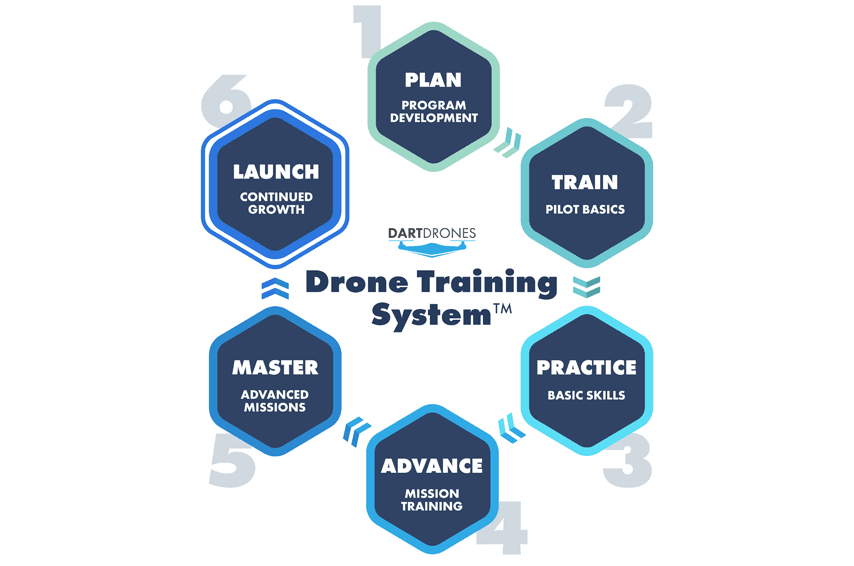
A strong approach combines structured aviation instruction with opportunities to apply those concepts through hands-on activities. Students can gradually build from foundational knowledge into exam preparation and professional-style drone missions.
DARTdrones’ High School Drone Curriculum for STEM & CTE Programs combines FAA knowledge, hands-on flight training, safety, and real-world applications to help schools create that progression.
Students who are ready for dedicated test preparation can also explore FAA Part 107 Test Prep.
Real School Result
Part 107 in the Classroom: One teacher using DARTdrones’ high school curriculum reported that 16 students took the FAA Part 107 exam and 14 passed. She also highlighted the course’s airspace and chart practice as a part of the curriculum she particularly liked.
Ready to Prepare Students for FAA Part 107?
Build Part 107 Into a Complete Drone Education Program
DARTdrones helps schools combine FAA knowledge with hands-on flight training, teacher support, and real-world drone applications.
Whether your students are beginning with foundational drone skills or preparing to earn their Remote Pilot Certificates, DARTdrones can help you create a pathway that supports both certification and career exploration.
Explore High School Drone Curriculum
Schedule a Call
Frequently Asked Questions About Part 107 for High School Students
Can a 16-year-old get a Part 107 drone license?
Yes. The FAA minimum age for a Remote Pilot Certificate is 16. The applicant must also meet the FAA’s other eligibility requirements and pass the initial aeronautical knowledge exam.
Can a 15-year-old study for Part 107?
Yes. Students can begin learning Part 107 material and developing aviation and flight skills before they are old enough to qualify for the certificate.
What is the official name of a Part 107 drone license?
The FAA calls it a Remote Pilot Certificate with a small UAS rating. “Part 107 license” or “commercial drone license” are commonly used informal terms.
What is on the FAA Part 107 exam?
The exam covers subjects including FAA regulations, airspace, weather, loading and performance, emergency procedures, airport operations, radio communications, aeronautical decision-making, and other areas related to safe small-drone operations.
Does a Part 107 certificate expire?
Certificate holders must complete FAA recurrent training every 24 calendar months to maintain aeronautical knowledge recency.
Does every student in a high school drone program need Part 107?
No. Students can develop valuable aviation knowledge, flight skills, safety awareness, technical skills, and career-readiness experience without becoming Part 107 certified. Certification can be an additional goal for eligible students interested in professional drone operations.