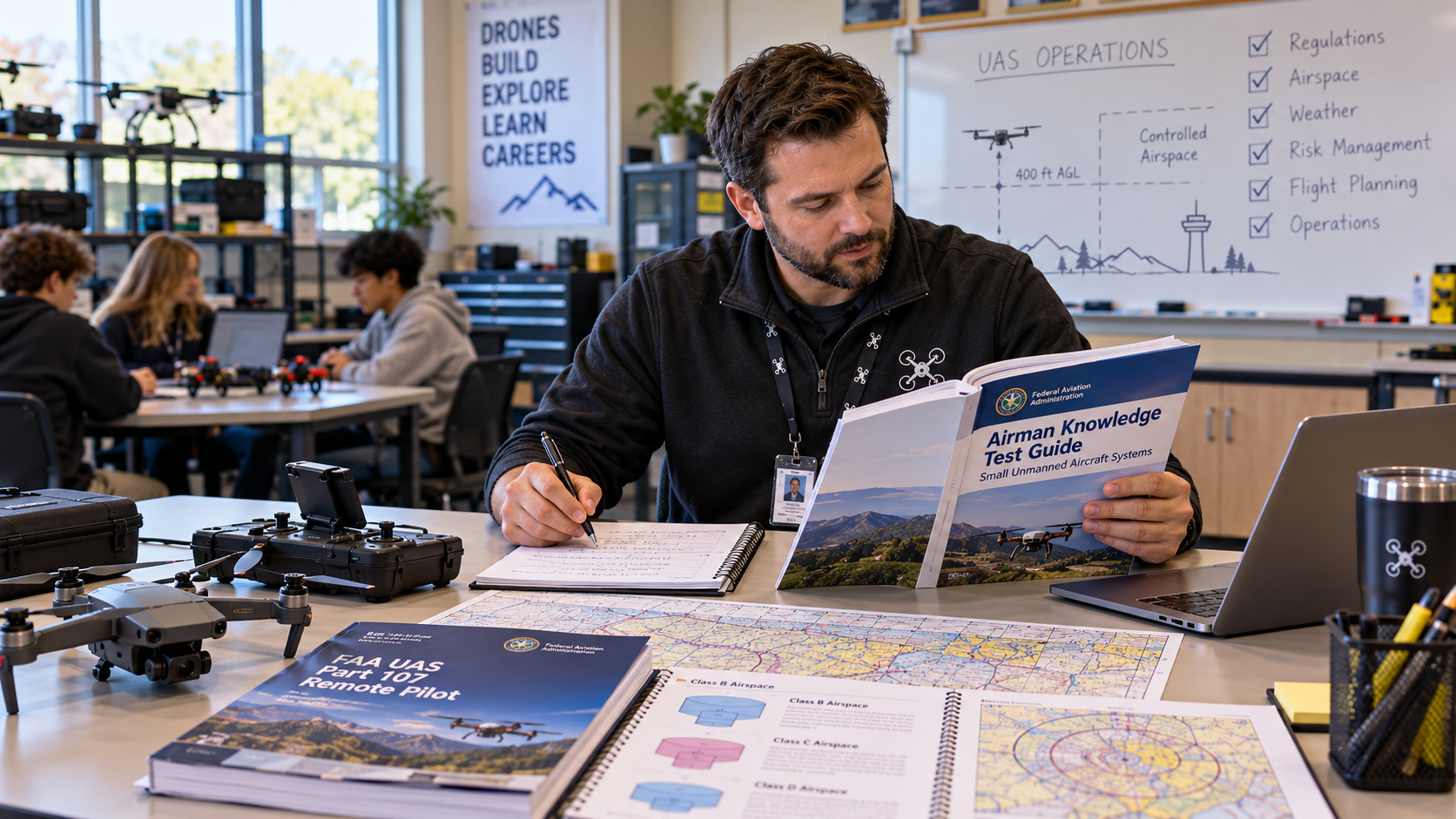
Does a Teacher Need a Part 107 Certificate to Teach Drones?
If you are preparing to teach a high school drone course, one of the first questions you may have is:
Do I need an FAA Part 107 Remote Pilot Certificate before I can teach drones?
The short answer is:
Not simply to teach the subject. But depending on how your school conducts its actual drone flights, a Part 107-certified remote pilot may be required.
There is an important distinction between teaching drone concepts in a classroom and acting as the remote pilot in command during a flight operation.
Understanding that difference can help schools prepare teachers appropriately without making FAA requirements sound more complicated—or more restrictive—than they are.
Part 107 Is a Pilot Certificate, Not a Teaching Credential
The FAA does not require someone to hold a Remote Pilot Certificate simply because they are teaching students about drones.
A teacher can introduce subjects such as:
- Aviation fundamentals
- Airspace
- Weather
- FAA regulations
- Flight planning
- Drone technology
- Safety
- Careers
- Part 107 exam topics
without Part 107 functioning as a separate “teacher certification.”
The FAA requirements become particularly important when the class begins conducting actual flight operations.
When Would a Teacher Need Part 107?
If a school conducts its flights under Part 107 and the teacher is acting as the remote pilot in command, that teacher must hold an FAA Remote Pilot Certificate.
The remote pilot in command is the person responsible for the safe operation of the aircraft.
Under Part 107, someone who does not hold a Remote Pilot Certificate may manipulate the flight controls if they are directly supervised by a certificated remote pilot in command who has the ability to immediately take direct control of the aircraft.
That distinction matters in a classroom.
A student does not necessarily need their own Part 107 certificate to practice flying during a properly conducted Part 107 operation. But there must be an appropriately certificated remote pilot in command supervising the operation and able to take control when required.
A Simple Way to Think About It
| Situation | Part 107 Consideration |
|---|---|
| Teaching drone concepts in the classroom | Part 107 is not required simply to teach the material |
| Teaching Part 107 test-prep topics | The teacher does not need the certificate merely to present the coursework |
| Acting as remote pilot in command under Part 107 | A Remote Pilot Certificate is required |
| Student flying during a Part 107 operation | Student may fly under direct supervision of a certificated remote PIC who can immediately take control |
| Qualifying educational operation under § 44809 | Part 107 may not be required if the organization and operation meet the applicable requirements |
Can Schools Fly Under Educational or Recreational Rules Instead?
Potentially.
The FAA specifically recognizes that drone flights conducted for educational purposes may operate either under Part 107 or under the Exception for Limited Recreational Operations of Unmanned Aircraft, depending on the organization and circumstances.
Qualifying educational organizations include:
- Institutions of higher education
- JROTC programs
- Educational programs chartered by an FAA-recognized Community Based Organization
For K–12 educational organizations that are not part of a JROTC program, the FAA states that the educational program must be chartered by an FAA-recognized Community Based Organization to operate under § 44809. Otherwise, the operation must be conducted under Part 107.
That is why schools should determine which FAA operating framework they plan to use rather than assuming that every school flight automatically requires Part 107—or that being a school automatically exempts the operation from Part 107.
FAA rules and guidance can change. Schools should review current FAA requirements when establishing or updating their drone flight procedures.
Why DARTdrones Still Recommends Part 107 for Teachers
Even in situations where a teacher is not legally required to hold Part 107 simply to teach the course, earning the certificate can still be extremely valuable.
A teacher who completes the same certification pathway students may eventually pursue gains firsthand experience with:
- FAA regulations
- Airspace
- Aviation weather
- Sectional charts
- Airport operations
- Emergency procedures
- Aeronautical decision-making
- The Part 107 exam itself
That knowledge can make it easier to answer student questions and connect classroom concepts to actual flight decisions.
DARTdrones Instructor Insight
DARTdrones instructors recommend that teachers who are preparing students for Part 107 consider earning their own Remote Pilot Certificate. Going through the process helps teachers understand the material from the student’s perspective while building a stronger foundation for supervising real-world drone activities.
Part 107 Knowledge Helps Teachers Explain the “Why”
A teacher does not just need to know that a rule exists. Ideally, they should be comfortable explaining why it matters.
For example, students studying Part 107 may encounter questions about:
- Controlled and uncontrolled airspace
- Weather conditions
- Visibility
- Airport operations
- Preflight planning
- Operational limitations
- Risk management
Understanding those subjects helps teachers move beyond memorization and apply the material to situations students may actually encounter. That becomes especially useful when classroom instruction is paired with hands-on flight activities.
Teachers Need Hands-On Flight Experience Too
Passing a knowledge test does not automatically make someone comfortable supervising students who are flying drones. Teacher preparation should include both aviation knowledge and hands-on practice.
Before leading student flight activities, educators should become comfortable with:
- Basic aircraft controls
- Preflight inspections
- Battery management
- Establishing a safe flight area
- Responding when a student loses orientation
- Taking control of an aircraft when necessary
- Managing multiple students around a flight activity
- Connecting flight exercises to classroom concepts
DARTdrones Instructor Recommendation
A strong teacher-preparation pathway combines:
Part 107 knowledge + hands-on flight training + curriculum familiarity + ongoing support
That foundation can be more valuable than simply handing a teacher a curriculum and expecting them to learn alongside the students.
What If the Teacher Has No Aviation Experience?
That is common.
A teacher does not need to enter a drone program with years of aviation experience. What matters is having enough preparation to confidently guide students and operate within whichever FAA framework the school is using.
DARTdrones instructors recommend that new drone teachers build a foundation through:
- Structured Part 107 education
- Hands-on flight practice
- Familiarity with the classroom curriculum
- Safety procedures
- Continued access to resources when questions arise
This also aligns with what DARTdrones has heard from teachers using its curriculum: structured materials and support can make it possible to teach drones even when the educator begins with limited previous drone experience.
For more guidance on teacher preparation, training, and support, see Can a Teacher Without Aviation Experience Teach a Drone Course?
A Teacher’s Perspective
One high school teacher using DARTdrones’ curriculum shared that the structured course made it possible for him to teach drones even though he began with limited prior drone knowledge and experience.
His experience reinforces an important point: teachers do not have to begin as drone experts. Structured Part 107 education, hands-on practice, teacher-ready curriculum, and ongoing support can help educators build the knowledge and confidence they need to lead a drone course.
Should Schools Require Their Drone Teachers to Earn Part 107?
That decision depends on how the program will operate, but for a career-focused high school or CTE program, having the lead teacher earn Part 107 can provide several benefits.
It can help the teacher:
- Understand the certification students are preparing for
- Answer Part 107 questions more confidently
- Apply aviation concepts during flight activities
- Serve as remote pilot in command for Part 107 operations
- Model professional aviation practices
- Build credibility and confidence as the program grows
For schools preparing students for professional drone careers, it is therefore reasonable to make teacher Part 107 certification part of the professional-development plan, even when the certificate is not technically required merely to deliver classroom instruction.
How Should a New Drone Teacher Prepare?
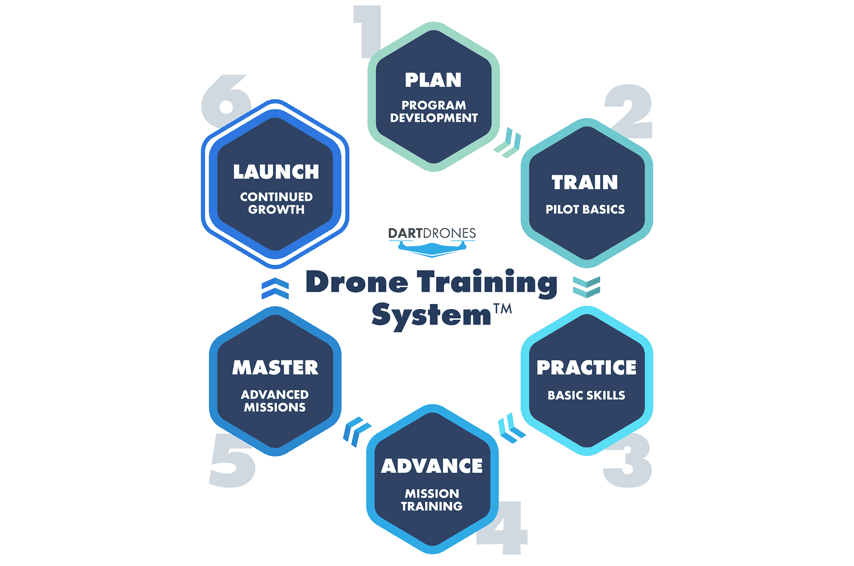
A practical progression could look like this:
1. Learn the Curriculum
Understand the course structure, student activities, assessments, and learning objectives.
2. Build Part 107 Knowledge
Study regulations, airspace, weather, sectional charts, operating limitations, and other Part 107 subjects.
3. Practice Flying
Begin with basic aircraft and build confidence before supervising student operations.
4. Determine Which FAA Rules the School Will Operate Under
Schools should establish whether planned flights will be conducted under Part 107 or whether the program qualifies to operate under § 44809.
5. Establish Flight Procedures
Define supervision, flight areas, equipment procedures, emergency response, and how students will transition from classroom knowledge to hands-on flying.
6. Continue Building Experience
Teachers do not need to know everything on day one. Continued flight practice, professional development, and access to knowledgeable support can help the program improve over time.
Part 107 Can Be Part of Teacher Preparation—Not a Barrier to Starting
Teachers should not assume they need to arrive at a drone program as experienced pilots. At the same time, schools should not overlook the value of preparing the teacher before students begin flying. Part 107 certification can give educators a strong aviation foundation and, when operations are conducted under Part 107, allow the certificated teacher to act as remote pilot in command.
The most important step is determining how the school plans to conduct its flights and then preparing the teacher for that operating environment. DARTdrones offers professional development designed specifically for educators, combining Part 107 preparation, hands-on flight training, curriculum implementation, and teacher support.
Explore Teacher Professional Development
Explore High School Drone Curriculum
Schedule a Call
Frequently Asked Questions
Does a teacher legally need Part 107 to teach a drone class?
Not simply to teach drone-related classroom material. Whether a Part 107-certified remote pilot is required for flight activities depends on the FAA framework under which those operations are conducted.
Does a teacher need Part 107 to fly with students?
If the operation is conducted under Part 107 and the teacher is acting as remote pilot in command, yes. Some qualifying educational operations may instead be conducted under § 44809 when all applicable requirements are met.
Can students fly without Part 107?
Under Part 107, a person without a Remote Pilot Certificate may manipulate the controls when directly supervised by a certificated remote pilot in command who can immediately take direct control of the aircraft.
Should a teacher earn Part 107 even if it is not required?
DARTdrones recommends it for educators teaching Part 107 content or leading career-focused drone programs. Going through the certification process can strengthen the teacher’s knowledge, confidence, and ability to relate the material to students.
Can a teacher without aviation experience teach drones?
Yes. Teachers can build the required knowledge and skills through structured curriculum, professional development, flight practice, and ongoing support.