What Equipment Do You Need for a High School Drone Program?

Starting a high school drone program does not mean filling a classroom with expensive professional aircraft.
The right equipment depends on what students will be learning, how many students will participate, the available flight space, and how advanced the program is intended to become.
For many schools, a practical approach is to begin with smaller training drones and the basic supplies needed for safe hands-on practice, then add a more advanced camera-equipped drone and specialized technology as students build their skills.
The goal is to purchase equipment that supports the curriculum—not to buy technology simply because it looks impressive.
Start With the Skills Students Need to Learn
Before choosing specific drones, start with the activities students will actually complete.
Will students be learning:
- Basic manual flight skills?
- FAA Part 107 concepts?
- Indoor obstacle courses?
- Outdoor flight operations?
- Photography and video?
- Automated missions?
- Mapping or photogrammetry?
- Inspection workflows?
- Other professional drone applications?
A beginner flight exercise has very different equipment requirements from an advanced mapping mission.
That is why curriculum and equipment planning should happen together.
1. Microdrones for Beginner Flight Training
Small training drones are a useful starting point for students who are learning how aircraft respond to control inputs.
They can allow students to practice skills such as:
- Takeoff and landing
- Hovering
- Orientation
- Basic flight patterns
- Precision control
- Obstacle navigation
- Landing in a designated area
DARTdrones Instructor Insight:
DARTdrones instructors recommend beginning students with small microdrones in an indoor environment where they can practice flying around objects and obstacles. The goal is to develop the motor skills required to control an aircraft before progressing into more advanced operations.
Drone simulators can also supplement hands-on practice, particularly when weather or equipment availability limits flight time.
Microdrones are especially useful because beginning students can focus on learning the controls without immediately being responsible for a larger professional aircraft.
2. A More Advanced Camera-Equipped Drone
As students become comfortable with basic manual flight, the program can introduce an aircraft that more closely represents what they may encounter in professional drone operations.
DARTdrones instructors recommend exposing students to different aircraft types over time, progressing from microdrones toward larger multirotor platforms.
A more advanced aircraft can support activities such as:
- Aerial photography
- Video
- Automated missions
- Mapping
- Photogrammetry
- Inspection exercises
- More advanced flight planning
DARTdrones’ current sample Unit 1 materials list calls for both a microdrone and an advanced drone with a camera, reflecting this progression from introductory flight practice to more advanced applications.
Does the School Need a Specific Brand of Drone?
Not necessarily.
The important question is whether the aircraft supports the skills and missions included in the curriculum.
Schools should consider factors such as:
- Ease of use
- Camera capabilities
- Flight stability
- Battery availability
- Replacement parts
- Controller compatibility
- Software requirements
- Intended student activities
- Current FAA requirements
DARTdrones’ teacher flight-training curriculum currently includes instruction on primary drone types and DJI systems, along with equipment setup, flight displays, battery status, emergency procedures, mission-specific settings, and autonomous flight.
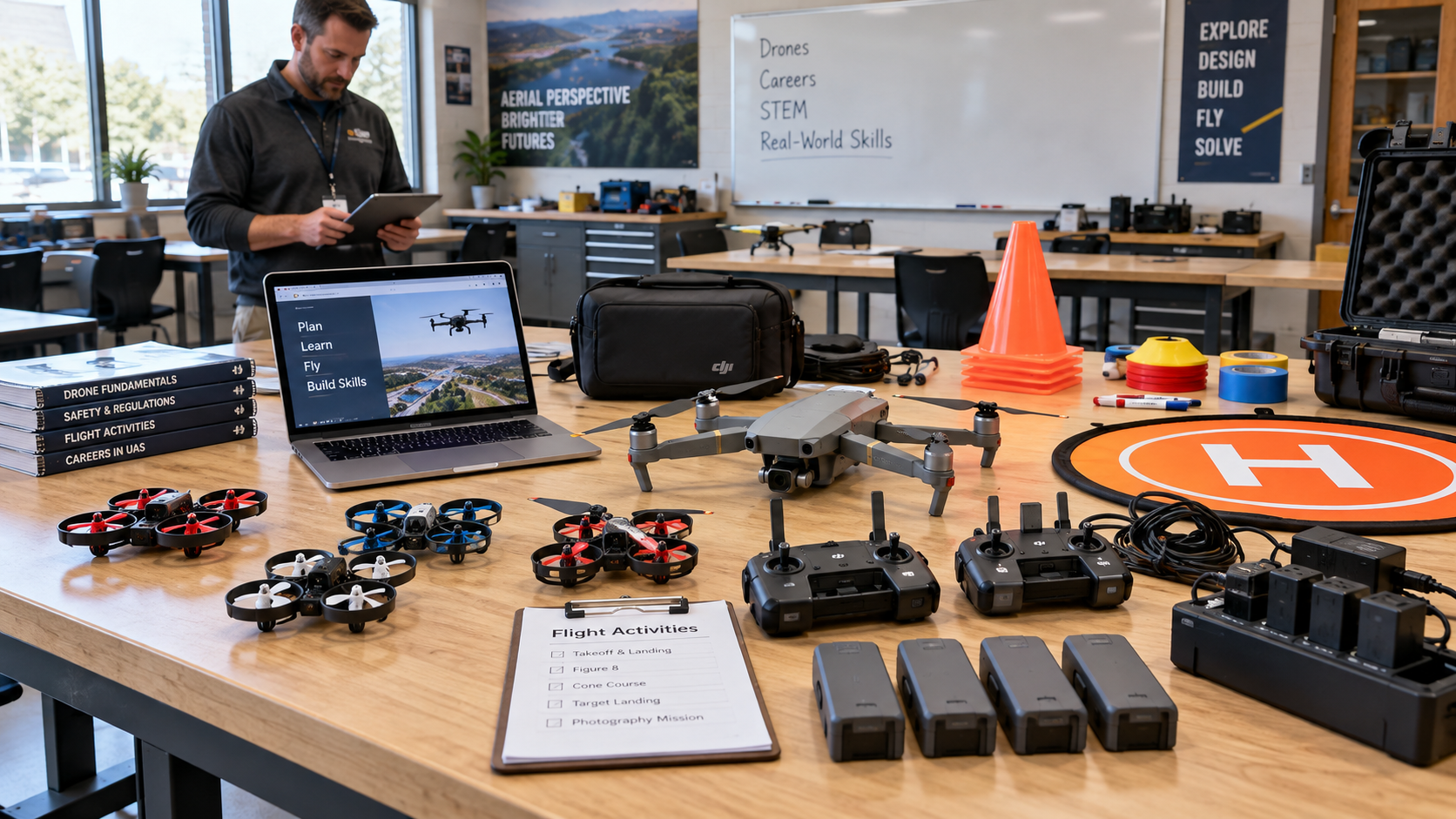
3. Controllers, Batteries, Chargers, and Replacement Parts
The drone itself is only part of the equipment budget.
Schools should also plan for the accessories necessary to keep aircraft operating throughout the semester.
That can include:
- Controllers
- Additional batteries
- Battery chargers
- Replacement propellers
- Spare parts
- Charging cables
- Landing pads
- Protective cases
- Equipment storage
Extra batteries can be particularly useful during hands-on activities because one battery may be charging while another is being used.
Schools should also think about how batteries will be charged, stored, inspected, and replaced over time.
DARTdrones Insight: Schools working with DARTdrones commonly purchase a combination of microdrones, a more advanced aircraft, and the accessories needed to support classroom flight activities.
4. Computers, Tablets, and Classroom Technology
Some of the necessary technology may already exist in the classroom.
Depending on the curriculum and aircraft being used, students or teachers may need access to:
- Computers or laptops
- Tablets or mobile devices
- Internet access
- A classroom display or projector
- Drone applications or flight software
- Curriculum or LMS access
- Mapping or mission-planning software for advanced activities
Before purchasing new devices, schools should determine what their existing technology can already support.
For example, DARTdrones’ sample Unit 1 materials list calls for the ability to display content from a computer but does not assume that every classroom needs an entirely new technology setup.
5. Equipment for Flight Activities
Schools may also need inexpensive supplies to create structured flight exercises.
These can be much simpler than the aircraft themselves.
The DARTdrones Unit 1 sample materials list includes items such as:
- Masking tape
- 12 cones
- A landing pad
- Stiff cardboard signs
- Basic classroom materials
- Microdrone
- Advanced camera-equipped drone
- Batteries
- Controller
That is a good example of why a flight lab does not necessarily require elaborate permanent infrastructure.
Cones, tape, landing markers, signs, and other simple supplies can be used to create:
- Obstacle courses
- Precision landing exercises
- Simulated missions
- Flight boundaries
- Navigation challenges
6. A Safe Place to Fly
Equipment planning also needs to account for where students will actually use the aircraft.
Indoor Flight
Microdrones can make it possible to introduce flight skills indoors, where teachers can create controlled exercises using cones, obstacles, landing zones, and other classroom materials.
The space should provide enough room for the planned activity and allow the teacher to establish clear boundaries around the flight area.
Outdoor Flight
Larger aircraft and more advanced missions may require an appropriate outdoor location.
Schools should consider:
- The surrounding airspace
- People and property nearby
- Physical obstacles
- Weather conditions
- Takeoff and landing areas
- Applicable school or district policies
- Applicable FAA requirements
Flight-space decisions should be made as part of program planning rather than after equipment has already been purchased.
7. Storage and Equipment Management
Buying the equipment is only part of the plan. Schools also need a simple system for charging, storing, inspecting, and tracking it.
It is also helpful to establish basic procedures for:
- Charging batteries
- Checking equipment before and after use
- Tracking damaged or missing parts
- Storing batteries appropriately
- Updating aircraft or controller software when needed
- Replacing worn components
A well-organized equipment system can make hands-on activities much easier for teachers to manage throughout the school year.
8. Consider Registration and Remote ID Before Buying Aircraft
Schools should also understand the FAA requirements that may apply to the aircraft they purchase.
The Federal Aviation Administration currently requires registration for most drones. One exception is a drone weighing 0.55 pounds or less—under 250 grams—when it is flown exclusively under the Exception for Limited Recreational Operations. Drones operated under Part 107 must be registered regardless of that recreational weight exception.
Drones that are required to be registered, or that have been registered, generally must also comply with the FAA’s Remote ID requirements. Compliance can come through built-in Standard Remote ID, an approved broadcast module, or qualifying operations within an FAA-Recognized Identification Area.
For schools, the takeaway is simple:
Do not evaluate an aircraft solely on price and features. Confirm that it will work for the type of operations your program plans to conduct.
How Many Drones Does a High School Program Need?
There is no single correct number.
The answer depends on:
- Class size
- Available flight space
- Length of the class period
- Whether students work individually or in teams
- Number of flight stations
- Battery availability
- How frequently students fly
- Whether the program uses different aircraft for different activities
A school does not necessarily need one advanced drone for every student.
It may make more sense to have multiple beginner training aircraft for frequent student practice while using a smaller number of advanced aircraft for structured missions.
This is also where classroom logistics matter. More aircraft are not always more useful if there is not enough space or instructor capacity to operate them safely at the same time.
What Equipment Is Essential at the Beginning?
DARTdrones Instructor Recommendation:
For a new program, prioritize:
- Beginner aircraft students can practice with — such as microdrones for fundamental flight skills.
- Access to a more advanced aircraft — so students can eventually apply those skills to professional-style operations.
- A structured curriculum — so every equipment purchase connects to a planned lesson, flight activity, or mission.
Specialized equipment for applications such as LiDAR, advanced mapping, or inspections can be added as the program grows.
Sample High School Drone Equipment List
| Category | Equipment to Consider |
|---|---|
| Beginner Flight | Microdrones |
| Advanced Flight | Camera-equipped multirotor drone |
| Controls | Controllers and compatible mobile devices where required |
| Power | Batteries, chargers, charging cables |
| Replacement Supplies | Propellers and common replacement parts |
| Flight Activities | Cones, landing pad, tape, markers/signs |
| Classroom Technology | Laptop/computer, display, internet access |
| Storage | Cases, bins, designated charging/storage area |
| Advanced Applications | Mapping, photogrammetry, automation, or mission-specific equipment as the program expands |
Build Your Equipment List Around the Program
Download: High School Drone Program Equipment Checklist
Schools do not need the largest drone fleet or most advanced technology to build a meaningful drone program.
Start with the equipment students need to develop fundamental flight skills. Add aircraft and technology as students progress toward more advanced missions and professional applications.
Most importantly, connect every equipment purchase to something students will actually learn or do.
DARTdrones’ high school drone curriculum combines Part 107 preparation, hands-on flight activities, real-world missions, and teacher resources designed to help schools build that progression.
Explore High School Drone Curriculum
See the Unit 1 Materials List
Schedule a Call
Frequently Asked Questions About High School Drone Equipment
What kind of drone should high school students start with?
Small microdrones can be useful for beginning students because they allow students to develop fundamental control and orientation skills before moving into larger aircraft and more advanced missions.
Does every student need their own drone?
Not necessarily. The number of aircraft a school needs depends on enrollment, flight space, class structure, available practice time, and whether students fly individually or in teams.
Does a high school drone program need an expensive professional drone?
Not necessarily. Schools can begin with beginner training drones and add a more advanced camera-equipped aircraft for professional-style applications. More specialized equipment can be added later as the program develops.
What accessories should a school budget for?
Schools should consider controllers, batteries, chargers, replacement propellers and parts, cases or storage, landing pads, and basic materials for flight activities.
Do school drones need to be registered with the FAA?
It depends on the aircraft and how it is operated. The FAA requires registration for most drones, including drones flown under Part 107. The under-250-gram registration exception applies only when a drone is flown exclusively under the limited recreational exception. Schools should verify which FAA rules apply to their planned operations.
Do school drones need Remote ID?
Drones that are required to be registered or have been registered generally must comply with the FAA’s Remote ID rule, unless an applicable exception or qualifying FRIA operation applies.