How Much Does It Cost to Start a High School Drone Program?

There is no single price for starting a high school drone program.
The total cost depends on how many students will participate, how long the course will run, what curriculum the school chooses, how much equipment is already available, whether teachers need professional development, and whether FAA Part 107 testing will be included.
For some schools, the goal may be to launch a small introductory program using a few inexpensive training drones and existing classroom technology. Others may be building a full semester or year-long CTE pathway with Part 107 preparation, advanced aircraft, teacher training, and real-world drone applications.
The best way to create an accurate budget is to start with the program’s goals and then determine what resources are actually needed to support them.
Start With the Size and Scope of the Program
Student enrollment is one of the biggest variables in the cost of a drone program.
The best way to create an accurate budget is to start with the program’s goals and then determine what resources are actually needed to support them. Depending on enrollment, teacher-training needs, and equipment choices, some schools may be able to launch an introductory drone program for under $5,000.
A small elective with 10 students may need fewer aircraft and student licenses than a full CTE course serving 20 or 30 students. The program format matters too. A short introductory course will generally have different equipment and curriculum needs than a semester or year-long program that includes Part 107 preparation and advanced flight applications.
Before building the budget, schools should determine:
- approximately how many students will participate,
- whether the program will run for a semester, full year, summer, or after school,
- whether Part 107 preparation is included,
- how much hands-on flight training is planned,
- and whether students will progress into more advanced drone applications.
DARTdrones Insight
Budget is the most common concern DARTdrones hears from schools considering a new drone program. Semester and full-year programs are the formats we most commonly see schools implement.
Budget for Curriculum and Student Access
Curriculum is one of the core program expenses because it gives teachers and students a structured path through aviation knowledge, flight training, safety, and career applications.
DARTdrones’ current Intro to Drones pricing is $200 for an individual student license, $1,500 for a package of up to 12 students, or $2,000 for up to 20 students. The course also includes teacher support and LMS access.
Schools looking for a shorter introduction can also consider condensed programs. DARTdrones’ 20-hour Intro to Drones Pop! course is currently priced at $250 for up to 10 students or $400 for up to 20 students.
Those figures give schools a starting point, but curriculum costs should be evaluated alongside the goals of the program rather than in isolation.
Include Teacher Training and Professional Development
A school may already have an educator with drone or aviation experience, but many do not.
Teacher preparation can include Part 107 study, hands-on flight training, safety procedures, curriculum implementation, and learning how to manage student flight activities. Investing in teacher preparation at the beginning can reduce the amount of trial and error once students are in the classroom.
This cost will depend on how much training the teacher needs and whether the school chooses online, virtual, or in-person professional development.
Plan for Drones and Other Flight Equipment
Equipment costs can vary significantly depending on the skills students will practice.
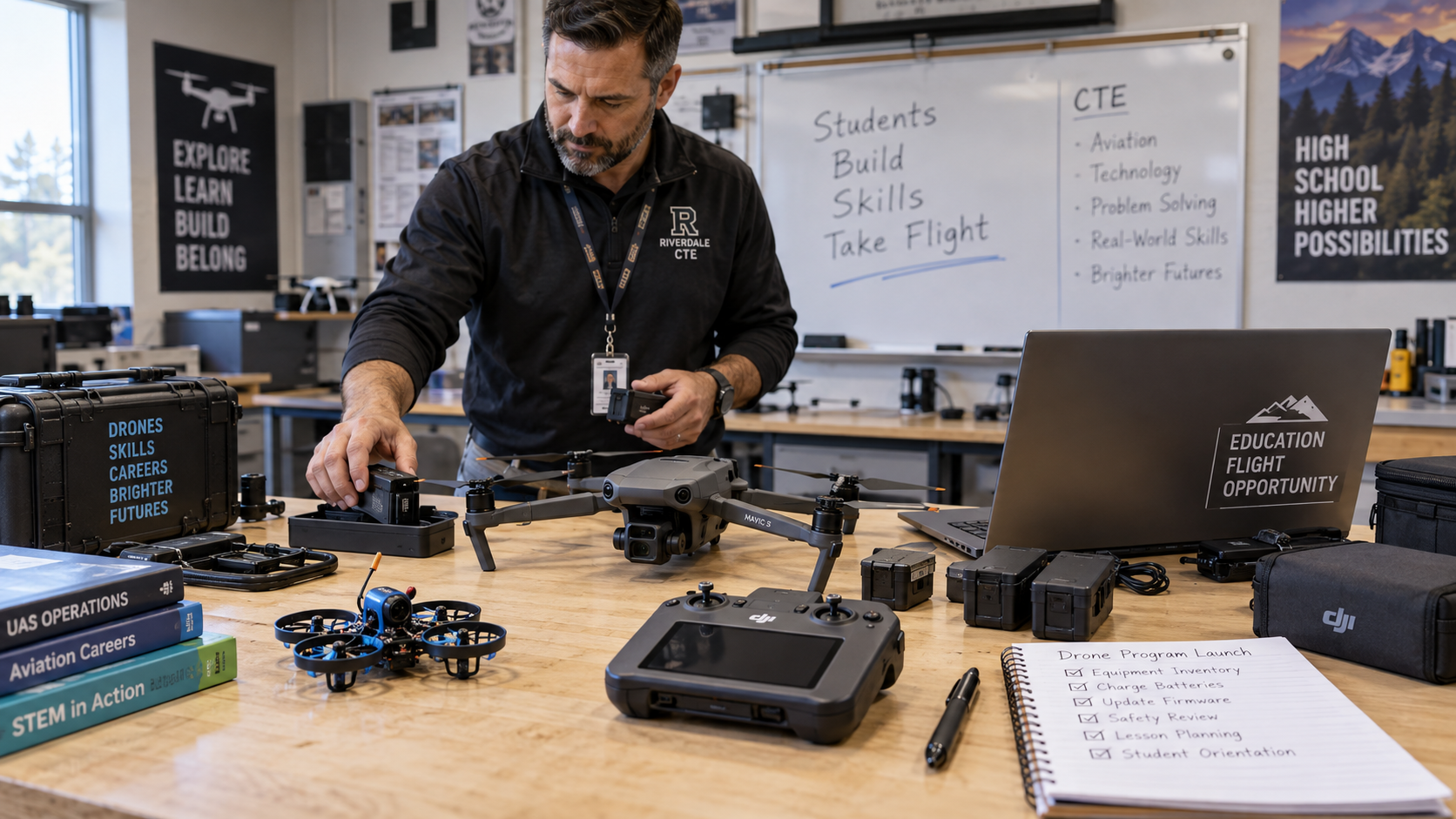
For a standard school program, DARTdrones currently recommends having at least a few microdrones for foundational flight work and one more advanced aircraft, such as a DJI Mini, Air, Mavic, or similar drone. The current high-school curriculum page gives an example of a roughly $40 microdrone for introductory flight activities.
Schools should also budget for supporting equipment such as controllers, batteries, chargers, spare propellers, storage cases, and replacement parts.
The goal should not be to buy the most advanced equipment immediately. Equipment should match what students will actually be learning.
DARTdrones Insight
Schools commonly ask DARTdrones about a combination of microdrones for beginner flight activities, a DJI aircraft for more advanced applications, and the accessories needed to support the course.
Account for Computers, Tablets, and Classroom Technology
Some schools may already have most of the classroom technology needed for a drone program.
If students will complete online coursework, research airspace, review weather information, take assessments, or use flight-planning tools, they will need reliable access to computers or tablets and an internet connection.
Schools should also consider whether the curriculum will need to integrate with an existing LMS, grading system, or classroom platform.
This may not create a new expense if those systems already exist, but it should be evaluated before implementation.
Don’t Forget Maintenance and Replacement Costs
Drone programs involve physical equipment, so the initial purchase price is not the entire equipment budget.
Batteries wear out. Propellers break. Small aircraft used by beginner students may experience crashes. Schools may also need additional charging equipment or replacement parts as the program grows.
It can be helpful to build a modest annual replacement and maintenance line into the budget rather than treating every equipment failure as an unexpected expense.
Decide Who Will Pay for FAA Part 107 Testing
If students will pursue FAA Part 107 certification, schools should decide whether the exam fee will be paid by the school, a grant, the student, or another funding source.
The FAA currently says testing centers charge approximately $175 for the initial aeronautical knowledge exam.
If 10 students take the exam, for example, that represents approximately $1,750 in testing fees alone.
That does not mean every student in the class must test. Schools can decide which students are eligible, prepared, and interested in pursuing certification.
Separate One-Time Costs From Recurring Costs
This distinction makes program budgeting much easier.
Typical startup expenses may include teacher training, initial drone purchases, charging equipment, storage, and classroom setup.
Typical recurring expenses may include student curriculum licenses, replacement parts, batteries, equipment maintenance, FAA exam fees, and additional equipment as enrollment or program needs grow.
Separating those categories helps administrators understand what the program will cost to launch versus what it may cost to maintain each year.
What Might a School Drone Program Budget Include?
| Budget Category | What to Include |
| Curriculum | Student licenses, teacher access, course materials |
| Teacher Preparation | Professional development, Part 107 prep, flight training |
| Training Drones | Microdrones or beginner aircraft |
| Advanced Drone | Aircraft for outdoor or real-world applications |
| Accessories | Batteries, chargers, controllers, propellers, storage |
| Classroom Technology | Computers/tablets if not already available |
| FAA Testing | Approximately $175 per student who takes the initial exam |
| Maintenance | Replacement parts and equipment repairs |
| Future Expansion | Advanced curriculum, additional drones, mission-specific tools |
Download DARTdrones’ High School Drone Program Budget Planner here.
Can Schools Start Small?
Yes.
A school does not necessarily need to purchase a fleet of advanced drones before the first day of class.
A smaller program can begin with structured curriculum, teacher preparation, inexpensive training aircraft, and existing classroom technology. More advanced aircraft and mission-specific training can be added once students develop foundational skills and the program demonstrates demand.
The key is to avoid cutting costs in areas that affect safety, teacher preparedness, or the quality of instruction.
DARTdrones Instructor Insight:
For a new high school drone program, DARTdrones instructors recommend prioritizing three things from the start: a lead teacher with genuine interest in drones and aviation, an engaging curriculum that includes plenty of hands-on flying, and access to more than one type of aircraft so students can build skills over time—from microdrones to larger multirotor platforms.
How Can Schools Pay for a Drone Program?
Funding varies widely by school and district.
Schools may use district budgets, CTE funds, STEM funding, workforce-development resources, grants, or other education funding sources depending on their circumstances and eligibility.
Ready to Build a Budget for Your School Drone Program?
Start With the Program You Want to Build
DARTdrones can help schools determine which curriculum, teacher training, equipment, and student resources fit their program goals and enrollment.
Rather than purchasing equipment first and figuring out the program afterward, schools can build the budget around the skills and outcomes they want students to achieve.
Explore High School Drone Curriculum
Schedule a Call
Frequently Asked Questions About High School Drone Program Costs
How much does a high school drone curriculum cost?
Pricing depends on the program and number of students. DARTdrones currently lists its Intro to Drones course at $200 for an individual student license, $1,500 for up to 12 students, and $2,000 for up to 20 students.
Do schools need an expensive drone for every student?
No. Schools can use shared aircraft and a mix of smaller training drones and more advanced equipment depending on the activities being taught.
How much does the FAA Part 107 exam cost?
The FAA says knowledge testing centers currently charge approximately $175 for the initial aeronautical knowledge test.
What is usually the biggest cost when starting a drone program?
It varies by school. Curriculum, student enrollment, teacher preparation, aircraft, equipment, and Part 107 testing can all affect the total. DARTdrones’ sales team reports that overall budget is the most common concern schools raise when considering a new program.
Can a school start a drone program on a smaller budget?
Yes. Schools can begin with foundational curriculum and lower-cost training drones, then add advanced aircraft and training as the program grows.